How to Set Up Hot Pot at Home Safely
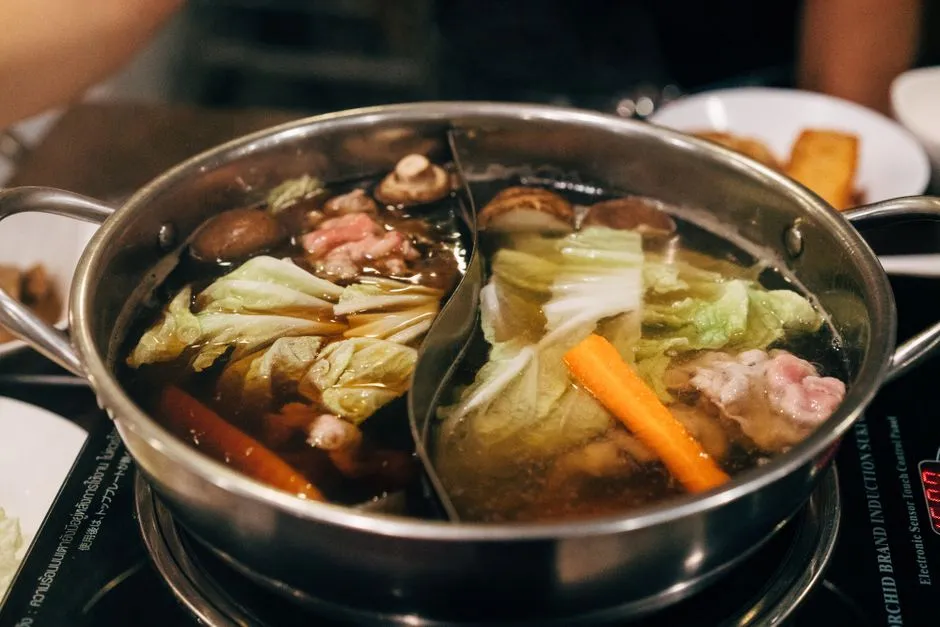
- Set up the table before the broth arrives
- Choose the cooking location first
- Check the surface, power, and reach
- Match the vessel to the recipe and appliance
- Build four table zones
- Prepare ingredients in the kitchen
- Start with enough hot broth for one batch
- Verify doneness outside the guessing game
- Keep the service temperature controlled
- Use individual bowls as the eating boundary
- Handle the final noodle or rice course carefully
- Shut down before clearing the table
- The final pre-service check
Set up the table before the broth arrives
To set up hot pot at home, choose an appliance explicitly approved for indoor tabletop use, place it on a stable heat-resistant surface, keep its cord and handles outside traffic paths, and leave a clear zone around the pot. Arrange raw ingredients, clean serving tools, individual bowls, and cooked-food utensils as separate stations. Cook in small batches, verify safe temperatures, and keep perishable food within controlled hot or cold holding limits.
This guide covers a Japanese-style home nabe table. It does not establish one official service tradition, and it does not turn camping equipment into an indoor appliance.
Choose the cooking location first
The safest tabletop plan uses equipment whose manufacturer explicitly permits the exact indoor use. Read the current manual for surface clearances, ventilation, compatible cookware, maximum load, liquid limits, cord placement, and shutdown.
An electric or induction cooker may be suitable if the manual allows tabletop cooking and the pot is compatible. Do not improvise with charcoal, a grill, or a portable gas camp stove indoors. The CDC’s current carbon monoxide guidance says never to burn charcoal indoors or use a portable gas camp stove indoors. Carbon monoxide is colorless and odorless and can cause sudden illness or death.
If the available equipment is not approved for indoor tabletop use, cook on the kitchen stove and ladle portions there. Tabletop simmering is optional. Fuel safety is not a cultural detail or a matter of atmosphere.
Check the surface, power, and reach
Use a level table that does not wobble under the combined weight of appliance, full pot, food, and serving pressure. Protect it with the heat-resistant base specified by the appliance manufacturer. Do not put the cooker on a cloth, flexible placemat, tray with a raised edge that makes it unstable, or surface damaged by heat.
Route the power cord directly to a suitable outlet without crossing a walkway, passing under a rug, hanging where a child can pull it, or touching the hot vessel. Do not use an extension cord unless the appliance manual explicitly permits one with the required electrical rating. Keep liquids away from plugs and controls.
Seat diners before positioning the cooker. Every person needs a stable bowl location and a clear route for hands that does not cross over the heat source. Children and anyone unable to manage boiling liquid safely should not sit within reach of the pot or cord.
Keep sleeves, hair, napkins, packaging, and serving baskets away from the heat. Make one person responsible for the cooker and broth level throughout the meal.
Match the vessel to the recipe and appliance
Use only cookware approved for the cooker. Induction requires compatible magnetic cookware; an oversized pot can extend beyond the supported heating area or make controls inaccessible. A pot that is too small can overflow when broth, vegetables, tofu, and protein are added.
Check four quantities:
- the appliance’s permitted cookware diameter and load;
- the pot’s usable capacity and any maximum fill line;
- the recipe’s starting liquid volume;
- the displacement from all ingredients added at one time.
Do not fill to the rim. Leave the headspace required by the pot and appliance instructions. If the recipe exceeds the safe working capacity, use a second pot or cook more batches. Do not carry a vessel full of hot broth across a crowded room to save one heating cycle.
Our chicken chanko-style nabe specifies 6 cups (1.44 liters) of starting stock and a 5- to 6-quart (4.7- to 5.7-liter) vessel. Those numbers belong to that recipe, not to every nabe.
Build four table zones
Organize the table so tools do not migrate.
| Zone | Contents | Boundary |
|---|---|---|
| Cooker zone | Appliance, pot, lid rest, heat-safe pot tool | Controlled by one responsible cook |
| Raw zone | Raw meat or seafood in shallow dishes, dedicated tongs | Never holds cooked food or eating utensils |
| Ready zone | Washed vegetables, tofu, noodles, garnishes | Kept away from raw juices and tools |
| Place settings | Individual bowl, chopsticks or fork, spoon, napkin | Eating tools do not return to raw dishes |
Use separate utensils for each raw protein and a clean communal tool for fully cooked food. If a raw utensil touches a plate or handle, treat that surface as contaminated until it is properly cleaned and sanitized.
USDA guidance on preventing cross-contamination directs cooks to keep raw meat, poultry, eggs, and seafood and their juices away from cooked and ready-to-eat food. Do not wash raw meat or poultry; splashing can spread contamination around the kitchen.
Prepare ingredients in the kitchen
Wash and cut vegetables first with clean equipment. Portion tofu, mushrooms, noodles, and garnishes. Only then open raw protein, using a separate board, knife, tray, and storage area.
Cut pieces to the dimensions in the recipe so the stated cooking order remains meaningful. Randomly large pieces can stay undercooked after smaller ones are ready. Keep raw protein refrigerated at 40°F (4°C) or below until it is needed, bringing out small replenishment trays rather than the whole supply when possible.
Read labels for allergens and alcohol. Soy sauce commonly contains soy and may contain wheat; dashi can contain fish; prepared broth can include several allergens; mirin and sake contain alcohol. Ask diners about needs before ingredients share one pot, because a communal broth cannot keep allergens in separate corners.
For the cultural and language context behind the meal, read what chanko nabe means and the chanko context hub. A home setup can be respectful without presenting itself as a sumo-stable practice.
Start with enough hot broth for one batch
Bring the broth to the recipe’s required boil or simmer in the kitchen or on the approved cooker. Do not overload the pot at the start. A cold pile of ingredients can drop the temperature, slow cooking, and make it difficult to track which pieces are ready.
Add ingredients in recipe order. Dense roots generally need an earlier start than leafy vegetables, but the actual sequence belongs to the specific recipe. Raw protein must be placed with its dedicated utensil. Do not use an eating utensil to move raw pieces.
After each raw addition, allow the liquid to return to the required simmer before treating elapsed time as meaningful. Keep the lid and controls accessible to the designated cook.
Verify doneness outside the guessing game
Use a food thermometer that can measure the thickest part of the pieces in the pot. Remove a representative piece to a clean small plate or spoon, insert the probe according to its manual, and check several pieces from different parts of the vessel. Clean the probe between uses as its manufacturer directs.
FoodSafety.gov’s safe minimum temperature chart gives these consumer endpoints:
- poultry: 165°F (74°C);
- ground meat and sausage: 160°F (71°C);
- whole beef, pork, veal, and lamb steaks, chops, and roasts: 145°F (63°C) followed by a three-minute rest;
- fin fish: 145°F (63°C), or flesh that is no longer translucent and separates easily with a fork;
- leftovers: 165°F (74°C).
For very thin or irregular pieces, use a thermometer designed for thin food and follow its insertion instructions. Color, bubbling broth, and “it has been in for a while” do not replace a valid measurement.
Do not let diners fish through the pot for pieces that are still cooking. The designated cook moves verified cooked food with a clean utensil.
Keep the service temperature controlled
Maintain the simmer specified by the recipe while active cooking continues. Once food is cooked, either serve it promptly or hold it at 140°F (60°C) or warmer. USDA’s hot-holding guidance gives that minimum for cooked or reheated food.
Measure the food, not merely the cooker setting. A numbered dial position does not guarantee a pot temperature across different appliances, vessels, room conditions, and ingredient loads.
Add broth only as the recipe or plan allows. Use hot broth if a cold addition would interrupt cooking, and do not exceed the safe fill line. Stop the cooker if the liquid level drops below the appliance or cookware requirement.
Keep the table dry. Wipe small spills only when it is safe to reach them. For a significant spill near electrical controls, follow the appliance’s emergency shutdown instructions and keep people away. Do not touch a wet plug or appliance.
Use individual bowls as the eating boundary
Transfer verified cooked food into individual bowls. Diners eat from those bowls rather than directly over the pot. Eating chopsticks, forks, and spoons stay at the place setting.
If a diner wants another portion, the clean communal cooked-food utensil retrieves it. Do not return a utensil from someone’s mouth or bowl to the shared pot. This boundary is simple enough to explain before service and difficult to reconstruct halfway through it.
Refill raw and ready zones from clean kitchen containers. Do not top a fresh tray by pouring it onto an older tray that has been at the table; replace the dish so time and temperature remain traceable.
Handle the final noodle or rice course carefully
Some nabe meals finish with noodles or cooked rice in the broth, often described as shime. The live chanko explainer discusses that option without treating it as mandatory. Japan’s Ministry of Agriculture, Forestry and Fisheries includes regional nabe examples in which udon may be added after the main ingredients, illustrating variation rather than one universal rule.
Use a final course only when the broth has remained safely hot, all raw ingredients reached their endpoints, and utensil handling stayed controlled. Bring the broth back to the required boil or simmer, add the measured noodles or cooked rice, and follow product instructions until the final ingredient is fully heated and cooked as applicable.
Do not save communal broth if its time, temperature, or utensil history is uncertain. Flavor concentration does not establish safety.
Shut down before clearing the table
Turn off the appliance using its control, then disconnect it only as the manual directs. Keep the pot in place until it is safe to move. Hot broth, handles, lid steam, and the heating surface remain burn hazards after the meal ends.
Do not pour hot broth into plastic bags, thin containers, or a sink while people are clearing around it. If leftovers are eligible for storage, divide them into shallow containers and refrigerate within two hours, or within one hour when the surrounding temperature is above 90°F (32°C). Refrigerate at 40°F (4°C) or below and reheat leftovers to 165°F (74°C).
Discard perishable food that exceeded safe limits or has an uncertain history. Do not keep raw ingredients that were repeatedly handled at the table unless their cold holding and contamination controls remained intact.
The final pre-service check
Before switching on the cooker, confirm:
- the appliance is approved for indoor tabletop use;
- the manual’s surface, clearance, cookware, power, and ventilation requirements are met;
- the pot is stable and below its safe fill limit;
- the cord, handles, and walking route are protected;
- raw, ready, cooked, and eating utensils are visibly separated;
- cold ingredients remain at 40°F or below;
- a suitable clean food thermometer is present;
- every diner’s allergens and dietary requirements are known;
- one person controls additions, doneness checks, and the appliance;
- shallow leftover containers are ready before service begins.
The home hot pot hub holds the measured recipes. A calm table comes from deciding these boundaries before steam obscures the view.